Sunday, 22 March 2015

7107 ISLANDS IN THE PACIFIC


Ever since two South Africans were abducted during their diving holiday in Sipatan, Malaysia, and kept hostage by Al Qaeda Rebels, in Jolo, Philippines, I have had a keen interest in this nation of islands. The Strydoms' 4-month ordeal in the year 2000, captured the hearts of all South Africans.  Their daily struggle to survive under death-threatening circumstances were followed by, not only all South Africans, but people across the world.  Today, Kallie and Monique, the founders of the Strydom Trust, are both national and international motivational speakers and bring messages of hope, miracles and survival.

Prior to this incident, my knowledge of the Philippines was restricted to Ferdinand and Imelda Marcos and Imelda's 3000 pairs of shoes.  Marcos, a dictator, was President of the Philippines from 1965 till 1986.  He was a genius with a photographic memory and passed his bar examination with an average of 98.1%.


F. Barcos Bar Topnotcher
Photo courtesy flipiknow.net
The Republic of the Philippines is a sovereign island in South East Asia situated in the Pacific Ocean.  It consists of more than 7000 islands, which are divided in three main regions: Luzon, Visayas and Mindanao.


Photo courtesy worldmaps


Gloria and I have been friends for many years and although we stay thousands of miles apart, we share the same interests, ambitions and ideologies.  We are from different cultures and backgrounds, but in essence we are really the same.  We are both passionate about our family and friends and cherish the joys of being a mother, a friend and nurturer for them.  During our working days we shared the challenges of being successful in a competitive corporate world,  a full time mom and housewife and a lover and friend to our significant others.

Gloria stays in the City of Bacolod, the capital of the province Negros Occidental, the “City of Smiles” or the “Sugar Capital” as it is referred to.  It is considered the most popular city in Western Visayas.  One of the highlights of the City of Bacolod is the Masskara Festival held during the 3rd week of October.  The City of Bacolod was ranked the “Best Place to Live in the Philippines” by Money Sense Magazine.

The colorful Masskara Festival is celebrated at the start of the winter season.  Masskara (“mass” and “kara”), which means mask and face, is a time for costumes, masks, float parades, beautiful gowns, drums and music, food, street parties and fireworks.  All in all, it’s a time to laugh, sing, celebrate and do what the Philippines do best, smile!  Their hospitality knows no end.

The Philippine cuisine is a fusion of many influences.  The Chinese, Europeans, Americans, Arabians and Asians were all early traders, immigrants or settlers and contributed to the food eaten in the Philippines today.  Their food is rich in color and flavor and mostly consists of seafood, fresh vegetables, meat and dairy.  Prior to the arrival of the Spanish their food consisted of root crops, game, vegetables and seafood.

Adobo, (the Spanish word for seasoning or marinade) is widely recognized as the “National Dish of the Philippines”.  When the Spaniards came to the Philippines in the 16th century they established a very unique cooking process with vinegar and referred to this method of cooking as “adobo”.  Traditionally, the adobo is cooked in a palayok, a small clay pot.

According to Yan Susanto an online writer “The flavour of this exquisite cuisine will certainly be liked by anyone who has tasted it the first time”.  Adobo is traditionally served with rice. Just like traditional dishes all over the world, many variations of this popular dish can be found. 

This is my version of this popular dish.

Adobong Baboy - Pork adobo

Pork or chicken can be used or a combination of both.

1 kilo pork cut into pieces - pork belly works well
1 large potato cut into pieces
1 onion chopped
2 heads of garlic crushed
2 bay leaves
1 teaspoon black peppercorns
6 tablespoons soy sauce
6 tablespoons vinegar 
1 cup water or rice water 
Cooking oil

Marinate the pork, garlic, bay leaves and soy sauce for half an hour
Sauté onion and marinated pork.  Add potatoes.
Add marinated sauce and water and simmer till the meat is soft.
Add vinegar and simmer for another 15 minutes.

Serve on a bed of rice or keep in fridge till the next day when the taste is even better


"Gusto kong bisitahin ang Pilipinas isang araw."


Photo courtesy Panlasang Pinoy Cookbook


Masskara Festival


Gloria receiving her employee of the year award.
Photo courtesy Gloria

Delivering her retirement speech
Photo courtesy Gloria

Employee of the Year award ceremony
Photo courtesy Gloria


Thursday, 19 March 2015

Motion Picture Medium and Live Performance


AFDA the South African School of  Motion Picture Medium and Live Performance is one of the leading film schools in the world.  With state-of-the-art campuses, AFDA teaches students to conceptualize, create and develop innovative products and commodities for the local and international market.

Students are encouraged to promote themselves as the cultural entrepreneurs of the future and to build profitable and sustainable careers in the entertainment industry.  More than 90% of AFDA's honors alumni are employed in their chosen field of specialization and they have reinvigorated industries with their talents.

AFDA trains graduates to contribute to the world of entertainment.  With campuses in Johannesburg and Cape Town, AFDA continually strives to renew their commitment in facilitating the development of skills to deal with the rigors of a fast-expanding and ever-changing entertainment industry.  AFDA's track record speaks for itself!

www.afda.co.za


Tuesday, 3 March 2015

Brandkos van Bhutan


My liefde-lysie is oneindig lank, maar as ek moet uitsonder, pryk mense, reis en kos heel bo-aan.   Die mensdom lê my baie na aan die hart.  Mense met weemoed en wanhoop, mense wat honger en dors na wie weet wat ookal.  Mense wat van hoogtes wil afspring oor hulle nie meer kan of wil voortswoeg nie.  Ou mense, siek mense, sterwendes, swanger dertienjariges, prostitute, padlopers en gehawendes.  Mense wat in gutters en onder sinkplate woon en mense wat elke dag die bottel of die spuitnaald nodig het om te oorleef.  Die wat my ken weet ek kruip graag in gate, hole en plakkerskampe in.  Ek dwaal op die afdraai- en pothole paaie.  Ek bedel vir die armes en omhels die boemelaars. 

Die lang pad tussen nêrens en êrens neem my met 'n ompad na die juwele van ons pragtige land.  Maar hierdie blog gaan nie oor my liefde vir reis, my land en/of die mense wat my pad kruis nie.  Nee dit gaan vandag oor my achilleshiel, kos!  Vreemde kos, etniese kos, kos wat ongemaklik voel op die Afrikaner tong en onbekend op die boere-volk oor.  Soos baie ander, lees hierdie vrou ook kosboeke eerder as die Ena Murray's en die Wilbur Smith's.

Laat ek dit baie duidelik stel, kosmaak soos in brêkfis vir vol fiemies kinders, middag-ete vir die tuinman en aandete vir pa en kroos staan my nie aan nie.  Dit bied geen uitdaging nie, want pa eet net rys, vleis en aartappels volgens sy ouma se resep en boet is op 'n Spur vleis-dieet.  Sus lewe van komkommers, ryskoekies en groen tee.  Hoe, vra ek jou, bly mens staande in die kombuis met so 'n uiteenlopende groep eters.

My kosreis, met behulp van boeke, mense en die kuber, neem my na vreemde lande.  Lande waar ek kennisse, vriende en selfs familie het.  Wie in Suid Afrika het deesdae nie meer familie iewers buite ons grense nie.  Mense wat moes trek oor die land te beklemmend geword het en oor baie ander redes.  Maar ek gaan nie vandag oor daardie mense praat nie.  Vandag wil ek vertel van my vriendin in Bhutan en hul liefde vir rissies.

Bhutan, Land of the Thunder Dragon, die piepklein, gelukkige landjie, versteek in en omring deur die magtige Himalayas, word regeer deur sy jong Koning Jigme Khesar Namgyel Wangchuck met sy pragtige Koningin, Jetsun Pema aan sy sy. Bhutan is nooit gekolonialiseer nie en sy inwoners is baie trots daarop.  Invloede van buite word nie maklik toegelaat nie.  Die meeste van die inwoners dra daagliks die nasionale drag, die kira vir vroue en die gko vir die manne, en almal drink botter-tee (Su Ja)  om warm te bly.


Ugyen, my paper friend, soos ons mekaar noem, en haar gesin, woon in Thimpu, die hoofstad van Bhutan.  Die enigste stad ter wêreld waar die verkeer nie deur verkeersligte beheer word nie, maar deur die plaaslike polisie met hul unieke handgebare.

Ugyen is ‘n ingenieur.  Sy bou paaie en brue en probeer lewe as Christen in ‘n land waar 99.9% van die bevolking Boedhiste is.  Alhoewel sy volhou dat die Christen God die een is wat sy nou wil dien, hunker sy terug na haar prayer flags-, kleurvolle shrines- en monastery dae.  Ek vermoed sy gaan nie lank as Christen staande bly nie.

Ons ken mekaar al jare en ruil ons land-stories, gesinsgeraamtes en kombuis-lekkertes met mekaar.  Sy het my bekendgestel aan onder andere, hul nasionale gereg, ema datshi, ‘n rissie-en-kaasbredie.  Ema datshi is weliswaar te warm vir die Afrikaanse tong, maar met 'n bietjie verbeelding en minder rissies bly dit ‘n gereg wat elke rissie- en kaasliefhebber ten minste een maal moet probeer.

Natuurlik is yakkaas nie beskikbaar in ons land nie, maar so deur die proe- en proefproses het ek gevind dat Deense Feta net so goed werk.  Hier is dus my aangepaste Afrikaanse weergawe van ema datshi.    Ema datshi word tradisioneel met rooi rys bedien.  Bykans onbekombaar in ons land, alhoewel ek dit tog al op ‘n rak of twee raakgeloop het.  Bruinrys of gewone langkorrel witrys werk goed as plaasvervanger.

Bestandele:
200 tot 250g groen rissies in lang repe gesny.  Verminder as jy nie kans sien vir al die hitte nie en verwyder maar meeste van die pitjies.
250ml water
1 groot ui fyn gekap
2  groot, ryp tamaties skilletjies verwyder en opgekap
1  groot aartappel in blokkies gesny
250g Deense Feta ook in blokke gesny – nie te klein nie
5 huisies knoffel fyn gekap
'n handvol koljander gekap
 2 eetl. kook-olie (nie olyf nie)
‘n Handvol ekstra wit harde of semi-harde kaas gerasper  (Cheddar, Emmethal, Bokmelk, Gruyer)
Gaar rys van jou keuse

Metode:
Braai uie en rissies liggies in olie.  Moenie verbruin nie. 
Voeg tamaties, knoffel en aartappel by en braai vir nog n paar minute.
Voeg water by en kook vir 10 minute.  Meeste water moet wegkook.
Voeg kaas by en prut saggies vir n minuut of twee.
Voeg gekapte koljander en die handvol gerasperde kaas by, plaas deksel op en skakel plaat af. 
Bedien met rys.


Bogenoemde dis is net vir die wat die hitte van 'n rissie kan vat.  Ek aanvaar geen verantwoordelikheid vir enige ongevalle nie.


Die manne in Ugyen se lewe.
Foto vergunning Ugyen.

Ugyen en haar gesin reg vir skool en werk.
Foto vergunning Ugyen


Koning en Koningin van Bhutan
Foto vergunning Imgur


Verkeerpolisie Thimpu
Foto vergunnign Imgur


Log Jay Gay. 


Monday, 23 February 2015

solitude


       one heart
       one soul
       one mind
       their loneliness


the eight word poem 20150222

Thursday, 18 December 2014

kinner klaaglied


ek huil in my hart                                                                            
my siel is morsdood                                                                                       
ek’s kwaad                                                                                                        
verpletter verslae                                                                                           
                                                                                          
die feestyd oorvloed 
stu in my op
die sang en jolyt
bring skuld en verwyt

daar is kinders in afrika
daar is kinders in bagdad
daar is kinders in gaza
daar is kinders in smart

jou  kinner koppie dra bakstene aan
jou lyfie verkoop om skulde te delg
jou handjies is nerfaf
jou ruggie is krom

ek huil in my hart
my siel is morsdood
vir jou liewe kind
is ons wêreld  so blind


Wednesday, 12 November 2014

A WALK DOWN MEMORY LANE

What better way to end my granny-gap-year than paying a visit to my country of birth.  My trip to Namibia, (previously known as South West Africa) has long been overdue and when the opportunity presented itself, there was no hesitation from my side. With the help of friends and family the trip was planned and we were ready to board the bus.  And, for the first time this year, I would not be behind the steering wheel.  I would be able to just sit back and enjoy the journey.  But, best of all, Mommy and Daddy granted permission for Missy, my granddaughter, to accompany me and I must admit it was good to have her all for myself after an absence of five months.

Namibia is one of the wealthiest countries in Africa, although the wealth is spread unevenly and most of it still belongs to the colonial whites while most of the black and coloured Namibians still live below the poverty line.

The distance between Cape Town and Windhoek, the capital and largest city of the Republic of Namibia, is approximately 1500km and the 20 plus hour bus trip is long and tiring.  We left Cape Town at 11h00 on a Tuesday morning and arrived in Windhoek at 08h00 the next morning where we were met by our family.  Luckily, Mommy booked us luxury bus seats on one of South Africa's popular sleep-liners, which made it possible for us to get a good night's rest.  It felt good to be on home ground after an absence of 14 odd years.

Windhoek borders Angola, Zambia, Botswana, South Africa and the Atlantic Ocean on the west.  Namibia gained independence from South Africa in 1990 and today is a member of the United Nations, The Southern African Development Community (SADC), the African Union and the Commonwealth of Nations.  It has a population of just over 2 million and regarded as one of the least populated countries of the world.  Its location between the Namib- and Kalahari deserts, makes Namibia one of the driest countries in sub-Saharan Africa.


MAP COURTESY NAMIBIA TRAVEL GUIDE

Our hosts for the duration of our stay in Namibia were Jaco, Suzette, Barend and Larushka who went out of their way to make it a holiday to remember.  Every single day was packed with fun, excitement, laughter and pure joy!  There was extraordinarily and unforgettably good food.  And, there were some other interesting eating and drinking experiences such as the monkey fruit (Strychnosspinosa) a juicy, sweet-sour yellow edible and the deliciously thirst-quenching Chardonnay on ice which was perfectly suitable for the rather warm Namibian climate.


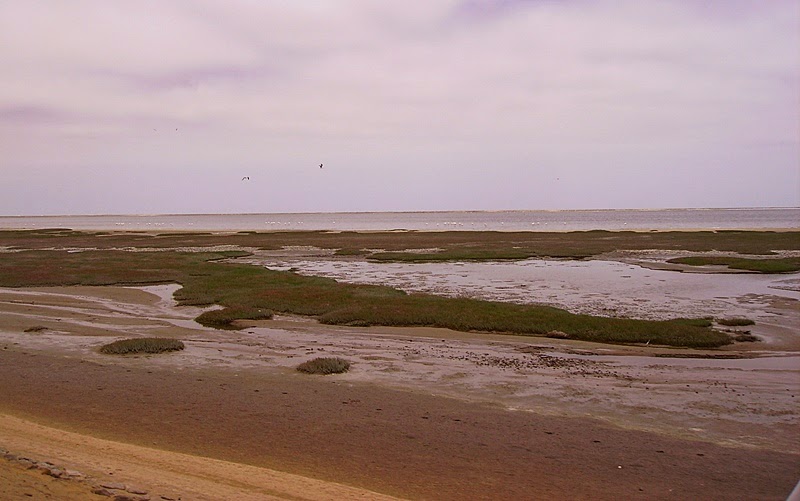
Our first major trip after arriving was a weekend outing to Swakopmund and we made stops at some special places from my childhood that brought back beautiful memories.  Swakopmund, a small town on the West Coast of Namibia, about 280km from Windhoek, is situated in the Namib desert.  The town was founded by Captain Curt von Francois, (a German) in 1892.  Today Swakopmund is still home to a large number of Germans.  The Mole, the name for the popular beach, along with the jetty, built in 1905 and recently restored, are some of the main attractions of the town.


I was born in a small town, named Usakos.  The name is a Damara word for 'grab the heel'.  (The Damara are an ethnic group that moved into the area in the mid-1800s, who speak the khoekhoe language, a Khoisan language, and which today make-up less than 10% of the Namibian population.)  Usakos lies on the banks of the Khan river and is surrounded by magnificent mountains and some of the longest uninterrupted horizons in the world.  Among those magnificent mountains is the almost 700 million year old Spitzkoppe or "Matterhorn of Namibia" which rises approximately 1800 meters above sea level.  
Unfortunately, Usakos, a once thriving boom-town, is one of many that has shown little or no growth since the mines and railway closed down in the 60's. Today, it is merely a town to pass by en route to Swakopmund and Walvis Bay on the coast.

We also had a quick stop at another small town where I spent many of my childhood Christmas holidays.  Karibib is the town where my grandmother used to stay and where I, as a child, spent many wonderful holidays in the company of cousins, aunts and uncles.  I was so surprised when I discovered her house still in the same condition as it was 50 odd years ago!


A visit to the Swakopmund Salt Works is a definite must on every tourist's list!  It is located on the road between Swakopmund and Walvis Bay.  Once there, we were treated to an almost unbelievable view of hundreds of flamingoes with a sea of pink and white salt in the background as far as the eye can see.  What more can a photographer, whether amateur or professional, ask for? It was picture-perfect as the saying goes.


Returning to Windhoek on Sunday afternoon came all too soon, but the next adventure was waiting.  My month-long stay in Namibia brought back so many memories.  Jaco and Suzette took us in and around Windhoek to so many lovely places.  
Whether it was a picnic, a sundowner, as it's known locally, in the middle of the dry Arebbusch River just outside Windhoek, or the kids having fun on the sand dunes on Barend's quad bike or maybe a drive in the veld with Piesang the Volla, (Volkswagen Beetle), every moment was one more to store in my memory file.  Will I ever forget the breath-taking views of a Windhoek sunset and the surrounding mountains from high up the hill at Hotel Thule overlooking Windhoek? 

Windhoek is a small city with a laid back atmosphere and nothing like Johannesburg or Cape Town in South Africa, where the cities never sleep.  But, Windhoek has its own fair share of sights, sounds and even surprises.  We drove by the impressive State House of Windhoek, the Heroes Acres and the so-called 'Condom' Building, the Clock Tower in the middle of the city, (it resembles the shape of a condom.)  We went for long walks in the neighbourhood, strolled through new shopping centres and not so new ones.  Everywhere there were memories to be made!

A visit to Katatura on the outskirts of Windhoek was one of the highlights of my visit to Namibia.  The Sam Nujoma Stadium and the two state hospitals are located in Katatura, which otherwise can be described as mostly a shanty town.  Parts of it however, compare well with any neighbourhood in the country and elsewhere.  Driving through the not-so-nice parts of Katatura just made me realise how lucky I am to live in a brick house, with running water and electricity at the tips of my fingers.  Katatura is a-buzz with street food markets, rhythmic African music, canteens and bars with names like the New York Bar and children playing happily in the dirt roads. 

The Dorob National Park along the Namibian Coast is one of the most unique coastal protected areas in Africa.  The park covers an area of approximately 110,000 square km.   It is part of a solid barrier of parks from the Kunene River on the Angolan border to the Orange River on the South African Border.  This particular park area attracts more than a million birds who fly in for a seasonal visit.  Amidst all these winged visitors is the Damara tern, an indigenous species and one of the more common ones known to the average tourist.  The aim of the park is to preserve the area and prevent further damage to this sensitive coastline. The feeding and killing of animals in this area is prohibited.  Although certain parts are set aside for tourism and recreational activities, most of the park is a no-go zone.


The Daan Viljoen Nature Reserve, 24km south of Windhoek is a haven for wildlife like the sprinbok, oryx (Gemsbok), Namibia's national animal, kudu, blue wildebeest, the zebra and klipspringer, plus more than 200 bird species.  The reserve has no large predators.  The Sun Karros, restaurant and luxury holiday accommodation was built  on the grounds of the park next to the Augeigas dam, where animals can be watched from up close.  


To end our holiday, our hosts took us on a game drive at Okapuka Ranch, 30km north of Windhoek.  Namibia is known for its wild life, game resorts and ranches.  It is a playground for hunters during the winter months and tourists flock to this remote land to experience Africa's wild life at its best.  

The day of our departure came all too soon and it was with sadness that Missy and I went aboard the bus for the very long and tiring 21- hour drive back home to where Mommy was anxiously waiting for her darling daughter to arrive.  I will miss the new friends I have made in Namibia.  Liezle, Maria, Bettie and Petrus and their lovely daughter and all the staff and kids at Wela Kapela School.


My gap year ended on a definite high!  I made lots of memories, met lots of new people, saw amazing new places and reunited with old friends and family, travelled the highways and the byways, faced challenges and potholes and overcame hurdles and breakdowns.  I worked, I played, I loved, I laughed, I sweated and I definitely cried when I had to say my farewells.  But, in the end, I can look back at 2014 and say: "I did it."
            
              Part of my soul was left in the sands of the Namib.  

“Anfangen is leicht, Beharren eine Kunst.” 
“Starting is easy, persistence is an art” 


GALLERY


My childhood church in Usakos

Church in Karibib


Clock Tower Windhoek

The Sleepliner

Swakopmund Salt works

View from bus window

Swakopmund jetty

Comforting a dying seal


Swakopmund 

Swakopmund

Swakopmund

Palm trees Swakopmund

Swakopmund

Namib desert

Colour in a grey town

Swakopmund Salt Works

Swakopmund Salt works

Salt Works

Salt


Flamingoes

Desert

Sand dune quad bikes

A day in the desert

African Art

The Namib sand and sun is hot

Dunes and ocean meet

Quad bike fun

The Mole


Pitstop in the Namib

My grandmother's house in Karibib


Daan Viljoen


Kids cooling off 

Monkey Orange

Mountains near Usakos

Flamingoes 


Where I was born many moons ago

Water tank at Usakos Railway station still standing after all these years

Adrenaline rush


Thanks to all who contributed in one way or the other to make 2014 my year to remember!


Friday, 24 October 2014

wandering woman


she speaks the language of passion
she listens to the songs of the wind
she walks the deserts, the woods and the hills 
she laughs with the hearing and cries with the blind.

her footprints lie scattered on the sand
her home is the ghettos, the streets and the land
her songs echo in the valleys below
her body sways to a silent beat

she lingers in forests
she dwells all alone
she ventures mist-shrouded mountains
she lives on the edge of forever

 her dreams are in colour 
 her cry a call  from the soul   
 to her, reality is just an illusion


141023jk

Featured post

FRIENDS 4/70

Friendship is one of life’s most cherished possessions. When it perseveres through the test of time, through decades of development, transfo...