Thursday, 18 December 2014

kinner klaaglied


ek huil in my hart                                                                            
my siel is morsdood                                                                                       
ek’s kwaad                                                                                                        
verpletter verslae                                                                                           
                                                                                          
die feestyd oorvloed 
stu in my op
die sang en jolyt
bring skuld en verwyt

daar is kinders in afrika
daar is kinders in bagdad
daar is kinders in gaza
daar is kinders in smart

jou  kinner koppie dra bakstene aan
jou lyfie verkoop om skulde te delg
jou handjies is nerfaf
jou ruggie is krom

ek huil in my hart
my siel is morsdood
vir jou liewe kind
is ons wêreld  so blind


Wednesday, 12 November 2014

A WALK DOWN MEMORY LANE

What better way to end my granny-gap-year than paying a visit to my country of birth.  My trip to Namibia, (previously known as South West Africa) has long been overdue and when the opportunity presented itself, there was no hesitation from my side. With the help of friends and family the trip was planned and we were ready to board the bus.  And, for the first time this year, I would not be behind the steering wheel.  I would be able to just sit back and enjoy the journey.  But, best of all, Mommy and Daddy granted permission for Missy, my granddaughter, to accompany me and I must admit it was good to have her all for myself after an absence of five months.

Namibia is one of the wealthiest countries in Africa, although the wealth is spread unevenly and most of it still belongs to the colonial whites while most of the black and coloured Namibians still live below the poverty line.

The distance between Cape Town and Windhoek, the capital and largest city of the Republic of Namibia, is approximately 1500km and the 20 plus hour bus trip is long and tiring.  We left Cape Town at 11h00 on a Tuesday morning and arrived in Windhoek at 08h00 the next morning where we were met by our family.  Luckily, Mommy booked us luxury bus seats on one of South Africa's popular sleep-liners, which made it possible for us to get a good night's rest.  It felt good to be on home ground after an absence of 14 odd years.

Windhoek borders Angola, Zambia, Botswana, South Africa and the Atlantic Ocean on the west.  Namibia gained independence from South Africa in 1990 and today is a member of the United Nations, The Southern African Development Community (SADC), the African Union and the Commonwealth of Nations.  It has a population of just over 2 million and regarded as one of the least populated countries of the world.  Its location between the Namib- and Kalahari deserts, makes Namibia one of the driest countries in sub-Saharan Africa.


MAP COURTESY NAMIBIA TRAVEL GUIDE

Our hosts for the duration of our stay in Namibia were Jaco, Suzette, Barend and Larushka who went out of their way to make it a holiday to remember.  Every single day was packed with fun, excitement, laughter and pure joy!  There was extraordinarily and unforgettably good food.  And, there were some other interesting eating and drinking experiences such as the monkey fruit (Strychnosspinosa) a juicy, sweet-sour yellow edible and the deliciously thirst-quenching Chardonnay on ice which was perfectly suitable for the rather warm Namibian climate.


Our first major trip after arriving was a weekend outing to Swakopmund and we made stops at some special places from my childhood that brought back beautiful memories.  Swakopmund, a small town on the West Coast of Namibia, about 280km from Windhoek, is situated in the Namib desert.  The town was founded by Captain Curt von Francois, (a German) in 1892.  Today Swakopmund is still home to a large number of Germans.  The Mole, the name for the popular beach, along with the jetty, built in 1905 and recently restored, are some of the main attractions of the town.


I was born in a small town, named Usakos.  The name is a Damara word for 'grab the heel'.  (The Damara are an ethnic group that moved into the area in the mid-1800s, who speak the khoekhoe language, a Khoisan language, and which today make-up less than 10% of the Namibian population.)  Usakos lies on the banks of the Khan river and is surrounded by magnificent mountains and some of the longest uninterrupted horizons in the world.  Among those magnificent mountains is the almost 700 million year old Spitzkoppe or "Matterhorn of Namibia" which rises approximately 1800 meters above sea level.  
Unfortunately, Usakos, a once thriving boom-town, is one of many that has shown little or no growth since the mines and railway closed down in the 60's. Today, it is merely a town to pass by en route to Swakopmund and Walvis Bay on the coast.

We also had a quick stop at another small town where I spent many of my childhood Christmas holidays.  Karibib is the town where my grandmother used to stay and where I, as a child, spent many wonderful holidays in the company of cousins, aunts and uncles.  I was so surprised when I discovered her house still in the same condition as it was 50 odd years ago!


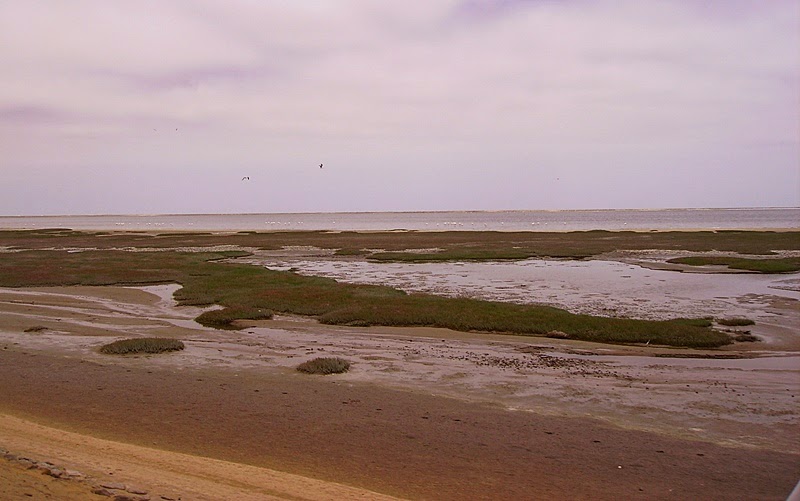
A visit to the Swakopmund Salt Works is a definite must on every tourist's list!  It is located on the road between Swakopmund and Walvis Bay.  Once there, we were treated to an almost unbelievable view of hundreds of flamingoes with a sea of pink and white salt in the background as far as the eye can see.  What more can a photographer, whether amateur or professional, ask for? It was picture-perfect as the saying goes.


Returning to Windhoek on Sunday afternoon came all too soon, but the next adventure was waiting.  My month-long stay in Namibia brought back so many memories.  Jaco and Suzette took us in and around Windhoek to so many lovely places.  
Whether it was a picnic, a sundowner, as it's known locally, in the middle of the dry Arebbusch River just outside Windhoek, or the kids having fun on the sand dunes on Barend's quad bike or maybe a drive in the veld with Piesang the Volla, (Volkswagen Beetle), every moment was one more to store in my memory file.  Will I ever forget the breath-taking views of a Windhoek sunset and the surrounding mountains from high up the hill at Hotel Thule overlooking Windhoek? 

Windhoek is a small city with a laid back atmosphere and nothing like Johannesburg or Cape Town in South Africa, where the cities never sleep.  But, Windhoek has its own fair share of sights, sounds and even surprises.  We drove by the impressive State House of Windhoek, the Heroes Acres and the so-called 'Condom' Building, the Clock Tower in the middle of the city, (it resembles the shape of a condom.)  We went for long walks in the neighbourhood, strolled through new shopping centres and not so new ones.  Everywhere there were memories to be made!

A visit to Katatura on the outskirts of Windhoek was one of the highlights of my visit to Namibia.  The Sam Nujoma Stadium and the two state hospitals are located in Katatura, which otherwise can be described as mostly a shanty town.  Parts of it however, compare well with any neighbourhood in the country and elsewhere.  Driving through the not-so-nice parts of Katatura just made me realise how lucky I am to live in a brick house, with running water and electricity at the tips of my fingers.  Katatura is a-buzz with street food markets, rhythmic African music, canteens and bars with names like the New York Bar and children playing happily in the dirt roads. 

The Dorob National Park along the Namibian Coast is one of the most unique coastal protected areas in Africa.  The park covers an area of approximately 110,000 square km.   It is part of a solid barrier of parks from the Kunene River on the Angolan border to the Orange River on the South African Border.  This particular park area attracts more than a million birds who fly in for a seasonal visit.  Amidst all these winged visitors is the Damara tern, an indigenous species and one of the more common ones known to the average tourist.  The aim of the park is to preserve the area and prevent further damage to this sensitive coastline. The feeding and killing of animals in this area is prohibited.  Although certain parts are set aside for tourism and recreational activities, most of the park is a no-go zone.


The Daan Viljoen Nature Reserve, 24km south of Windhoek is a haven for wildlife like the sprinbok, oryx (Gemsbok), Namibia's national animal, kudu, blue wildebeest, the zebra and klipspringer, plus more than 200 bird species.  The reserve has no large predators.  The Sun Karros, restaurant and luxury holiday accommodation was built  on the grounds of the park next to the Augeigas dam, where animals can be watched from up close.  


To end our holiday, our hosts took us on a game drive at Okapuka Ranch, 30km north of Windhoek.  Namibia is known for its wild life, game resorts and ranches.  It is a playground for hunters during the winter months and tourists flock to this remote land to experience Africa's wild life at its best.  

The day of our departure came all too soon and it was with sadness that Missy and I went aboard the bus for the very long and tiring 21- hour drive back home to where Mommy was anxiously waiting for her darling daughter to arrive.  I will miss the new friends I have made in Namibia.  Liezle, Maria, Bettie and Petrus and their lovely daughter and all the staff and kids at Wela Kapela School.


My gap year ended on a definite high!  I made lots of memories, met lots of new people, saw amazing new places and reunited with old friends and family, travelled the highways and the byways, faced challenges and potholes and overcame hurdles and breakdowns.  I worked, I played, I loved, I laughed, I sweated and I definitely cried when I had to say my farewells.  But, in the end, I can look back at 2014 and say: "I did it."
            
              Part of my soul was left in the sands of the Namib.  

“Anfangen is leicht, Beharren eine Kunst.” 
“Starting is easy, persistence is an art” 


GALLERY


My childhood church in Usakos

Church in Karibib


Clock Tower Windhoek

The Sleepliner

Swakopmund Salt works

View from bus window

Swakopmund jetty

Comforting a dying seal


Swakopmund 

Swakopmund

Swakopmund

Palm trees Swakopmund

Swakopmund

Namib desert

Colour in a grey town

Swakopmund Salt Works

Swakopmund Salt works

Salt Works

Salt


Flamingoes

Desert

Sand dune quad bikes

A day in the desert

African Art

The Namib sand and sun is hot

Dunes and ocean meet

Quad bike fun

The Mole


Pitstop in the Namib

My grandmother's house in Karibib


Daan Viljoen


Kids cooling off 

Monkey Orange

Mountains near Usakos

Flamingoes 


Where I was born many moons ago

Water tank at Usakos Railway station still standing after all these years

Adrenaline rush


Thanks to all who contributed in one way or the other to make 2014 my year to remember!


Friday, 24 October 2014

wandering woman


she speaks the language of passion
she listens to the songs of the wind
she walks the deserts, the woods and the hills 
she laughs with the hearing and cries with the blind.

her footprints lie scattered on the sand
her home is the ghettos, the streets and the land
her songs echo in the valleys below
her body sways to a silent beat

she lingers in forests
she dwells all alone
she ventures mist-shrouded mountains
she lives on the edge of forever

 her dreams are in colour 
 her cry a call  from the soul   
 to her, reality is just an illusion


141023jk

Wednesday, 22 October 2014

AN AMERICAN ON AFRICAN SOIL


I love this troubled country of mine very much and showing it off to foreigners makes me proud to be a South African.  Yes, we have crime.  Yes, we have potholes and an e-toll system that does not work!  We have racial tension and corruption that is crippling our economy.  Our local and national politics are bewilderingly muddled and our politicians overly self-absorbed!  Health, education and basic services, like water and power for an ever-growing population are seemingly always on the verge of near collapse.  Yet, South Africa survives, thrives and moves forward.  

South Africa is a rare mix of modern development in big cities like Johannesburg, Cape Town and Durban and of African tribal culture where people still live in huts scattered over the valleys and hills.  Wild life, which includes the Big Five, (lion, leopard, elephant, buffalo and rhino) attracts tourists from all over the world and many regard a visit to South Africa as incomplete without having spotted all five of them.  This view of South Africa is counter-balanced by the rest of the nation's economic diversity that includes everything from agriculture to mining to telecommunications and manufacturing, among other industries. Yet, the nation is plagued by high unemployment and stark poverty.  South Africa is truly a land of contrasts.


My love for people and my love for travel were combined when I had the opportunity to travel with an American who wanted to experience South Africa in the company of a local, away from the formal guided tours who only show-case the good and the best to the tourists and foreigners.  This American wanted to see South Africa as we South Africans see it, live it and love it.


I felt a bit apprehensive about his visit and wondered how South Africa would look through the eyes of an American.  It was, therefore, not without a bit of reluctance and a touch of cynicism that I approached this new adventure.  The average American, of what I've learned, prefers a holiday in more exotic places and my impression has always been that only the brave and not 

faint-hearted will wander off to Africa.  How can this small piece of land in this big, mostly third-world continent compare to the USA enough to impress any American?  For after all, America is the place where things are bigger, better, faster, most assuredly newer and definitely not third-world.  Despite these concerns, I geared up and made myself ready to entertain the American with true African hospitality.

Although I was born in Namibia, I have lived in South Africa since childhood.   I have experienced life both pre- and post-Apartheid.  I’ve lived through the pains and shames of the past and like so many of my fellow countrymen have dreams and hopes for this beautiful Rainbow Nation of ours.


But, this blog is not about my patriotism, but about a journey with the American, as he will be referred to for the purpose of this blog.  Although it was not his first visit to our country, Cape Town and the surrounding areas were still a treasure to be explored.


Aerial View Cape Town - photo courtesy Panoramio

The Western Cape, like so many other parts of our country, never disappoints.  We visited some of the oldies, some new developments and some not so popular and familiar sites.  Of course, time was limited and the options endless.  Cape Town, or the Mother City, as it is referred to by South Africans, offers the visitor a bounty of jewels, starting with Table Mountain, one of the new seven wonders of the world, and Robben Island, along with numerous wine routes, outdoor activities and scenic vistas.  The choices are many and varied with hardly a one that might cause anyone to experience ennui.  


Came the day and the American arrived having spent almost 26 continuous hours in airports or on a plane.  But, after a good night's rest it was all systems go.  Time flies when you have a city to explore, but even Americans need a break to rest and recharge, notwithstanding the popular notion to the contrary.


I intentionally made the Afrikaans Language Monument our first stop.  Where better to learn about the Afrikaans language and its history in South Africa?  So, off to Paarl Mountain we went to see the monument towering high, overlooking the valley far below


Construction of the monument, designed by architect Jan van Wijk, began in 1972 and was completed at the end of 1974.  Van Wijk was given instruction to design a monument to be visible from afar and depict the cultural and political blooming of Afrikaans,which today is only one of 11 official languages spoken in South Africa.


Our next cultural stop was at the Rhodes Memorial, situated on the slopes of Devil's Peak in Cape Town.  Cecil John Rhodes, a businessman, mining magnate, politician and arch imperialist was one of the more controversial historical figures in the history of South Africa.  Rhodes played a big role in the Jameson Raid which contributed to the outbreak of the Anglo Boer War.  The monument was designed by Sir Herbert Baker and resembles a Grecian temple with 8 bronze lions and a larger than lifes statue of a horse and rider overlooking the Cape Flats spread out below.


Two days of cultural tours were followed by a visit to the ever so popular Butterfly World, a tropical garden situated in Klapmuts, a small town in the centre of the winelands.  It is home to tropical lepidoptera and invertebrates as well as small animals that thrive in a tropical climate.  Butterfly World also seeks to educate visitors by promoting natural habitat protection and reducing the trading of wild animals as pets.


The Victoria and Alfred  Nthuli Waterfront is a popular hangout, not just for locals, but a must see for any person visiting Cape Town for the first time.  At Nobel Square, larger-than-life bronze statues of some of South Africa’s most famous men and Nobel Prize winners tower over the waterfront.  President Nelson Mandela, Albert Luthuli, Archbishop Desmond Tutu and former State President FW de Klerk all played a significant role in the history of this land.  A cruise on one of the many vessels traversing the harbour gives the visitor a striking view of the Waterfront and the harbour.  Close up views of fishing vessels, cargo ships in action and seals lazing in the sun all form part of a day at the Waterfront.


I must admit that at this point of the journey I was less worried about the American being disappointed in what South Africa has to offer.  In between our trips from one destination to another we made stops at more mundane locations; shops, malls, grocery stores, farm stalls, restaurants, parks and neighbourhoods both upscale and not so.  At all of these the American could clearly see the differences between what he saw and what he was used to seeing in the States.  I am sure he apreciated how my country is unique in its own special ways.  But, he also commented on the many similarities in the ways that people interacted while going about their everyday lives.  It's possible we may not be that different after all.


A visit to the penguin colony, at Stony Point in Bettys Bay, was another highlight for both the tourist and the tour guide.  This site is one of only 2 mainland-based penguin colonies in South Africa and home to the Jackass or African  penguins as it is called locally.


Bettys Bay, a former whaling station where whales were once killed by the hundreds for their oil, is now the breeding ground for the Jackass penguin.  Stoney Point is a designated protected area and a safe haven for the endangered Jackass penguin.  Penguins are monogamous and breed throughout the year and, although they all look the same to us, they seem to have no problem identifying their mating partners.  The female lays 2 eggs at a time and she and her partner take turns incubating the eggs.  The average height of a full grown penguin is approximately 70cm and it can weigh up to 3kg.


A visit to Cape Town is not complete without a stop at a wine cellar or two and preferably a tour on one of the many wine routes. Unfortunately, it was a public holiday and the options were limited, but nothing could dampen our enthusiasm.  A visit to the very popular Fairview Wine and Cheese estate was a good choice. 


What better way to see Cape Town by night than taking a walk down Long Street?  Arguably, Cape Town's night-life center, Long Street offers restaurants, night clubs, music, dancing, shops and street vendors.  It is a seemingly Bohemian bazaar with endless car traffic and equally crowded sidewalks.  The atmosphere is punctuated by the aroma of international cuisines from Europe, Asia, Latin America, and, of course, Africa, and the music of every variety pouring out to the street-level in undulating, rhythmic waves.  Our visit there was truly and experience!


After a night out in the city, the two oldsters (for the American and I share the same age bracket) needed a more leisurely pastime. And, so a drive out in the country seemed the thing to do.  We drove in a westerly direction towards Yzerfontein (iron fountain) which proved to be the right choice.  The West Coast has a beauty all its own with unspoiled, windswept landscapes and a beautiful coastline.  The magic of the West Coast lies in its uniqueness and its people who live an unpretentious lifestyle.  One of the main attractions to Yzerfontein is its 16 Mile Beach which is, of course, the longest uninterrupted sandy beach on the South African Coastline.  A leisurely stroll along the beach was a perfect late-morning excuse for a break before we continued our day-trip. 


From Yzerfontein we took the road inland to a small town named Darling.  Darling is situated 75km from Cape Town in the west coast region.  Darling was founded in 1853 and named after Sir Charles Henry Darling who came to South Africa in 1851 as a Lieutenant Governor.  Although Darling has many points of interest, South Africans associate the town with the well-known South African satirist, Pieter Dirk Uys.  Uys is famous not only for his cabarets and shows, but also for the charity work he does in the impoverished communities in and around Darling.  Uys converted the old railways station into a cabaret venue called "Evita se Perron" (platform) which is typical of Uys' satirical style that abounds with puns and other word-play such as the aptly named entrance area, "Piazza DolcEvita" or the sign identifying one of the several garden sections, "Boerassic Park", dedicated to Boere memorabilia (white men were called Boere (farmers) during the Apartheid era).


Our itinerary was packed with adventures: some large and some small.  But, isn’t that the stuff of life?  Yet, time, as we all know, is always a problem, most especially when one is having a good time.  At this point in our journey I was convinced  the American was appreciating and enjoying what South Africa has to offer just as much as the patriotic African.  Throughout, the American had many questions and we had many discussions about things we had done, the places we had visited and the wonders of this great land which I believe so fully engaged him.  Still, our adventures were not quite over.

A 9km drive down Chapman's Peak Drive (Chappies as it is called by the locals) is another must-see for any visitor to Cape Town.  The Drive is built on top of a layer of granite with softer rocks towering above.  It is one of the most scenic routes in the world.  It is also famous for two of South Africa's biggest races, namely, the Cape Argus Cycle Race and the Two Oceans Marathon.  Both attract runners and bikers from across the globe.  More of this scenic, dangerous and amazing piece of engineering can be read at: 


           http://www.candor.com/chapmanspeak/history.htm


Traversing Chapman’s Peak across the Drive summit and all the way down to the other side, we took the road to Hout Bay.  No trip to Hout Bay is complete without a visit to Mariner's Wharf, famous for its fresh fish and fries or 'slap chips' (soft fries) as they are called in South Africa.  Thousands of visitors, both internationals and locals visit Hout Bay during peak season for the shops, the scenery, the seals and the seafood.  Mariner's Wharf was the brainchild of Stanley Dorman, who designed Africa's first harbour-front emporium. It was officially opened in 1984.


Kirstenbosch Botanical Garden was next on our list and a visit to this remarkable garden is one of the highlights of any tourist's visit to South Africa and in particular Cape Town.   It was established in 1913 to promote and conserve the rich indigenous flora of South Africa.  Today it is home to over 7000 species of plants.  Kirstenbosch is part of a nature reserve and borders the Table Mountain National Park.  In 2004, Kirstenboch was declared a World Heritage Site by UNESCO.  I suspect this was one of the favorite stops for the American as there was no trail or pathway that we did not follow even to the point of leaving the grounds of the Garden and onto one of the many trails leading up the side of Table Mountain.  After all that walking and climbing to there and back again, it was no wonder that we both were hungry and thirsty.  Thankfully, a rather excellent restaurant, Moyo’s, is on the Garden premises.  We stopped and enjoyed a very good meal and, of course, some delicious South African white wine. 


To cap off our tour of Cape Town and its environs we paid a visit to Cape Point which is situated in a section of the vast Table Mountain National Park.   Both of us afterwards agreed that Cape Point was the indisputable highlight of the tour.  In 1448, Bartholomeus Dias named it the Cape Of Storms and not without good reason.  Sailors treated it with respect, because of the violent storms, fog and dangerous rocks that caused many a ship to sink or to be wrecked.  Eventually, the first lighthouse was built in 1859 and is still a popular tourist attraction.


Contrary to popular belief, Cape Point is not the place where the cold Atlantic Ocean and the warmer Indian Ocean collide.  That distinction belongs to Cape Agulhas, a little town 150 kilometers to the east-southeast of Cape Town.  This also makes Cape Agulhus the southernmost point of the continent of Africa.  But, Cape Point is not without its own unique appeal.


The Cape Point Nature Preserve is comprised of over 7700 hectares of nearly pristine hills and valleys accented by rocky escarpments and cliffs that drop straight down into a restless sea.  There are lighthouses and trails that wind their way up and down and around from one end of the preserve to the other.  From any point there are picturesque views in any direction.  It’s like a photographer’s paradise.  No better example of this is Diaz Beach which is at the tip of Cape Point and generally regarded as one of the most scenic beaches in South Africa, if not in the entire continent.  Access to this beach from the cliff edge above is made via a series of wooden stairs and can take as long as 20 to 30 minutes going down.  Coming back up, of course, can even take longer.   


Our visit to Cape Point left us exhausted, but thoroughly satisfied for having visited a truly wondrous place.  The American compared it to the feeling he had on the occasion of seeing the Grand Canyon for the first time even though both places are quite dissimilar.  But, he said that both places displayed the forces of nature and time working together to produce something quite unique that all the capabilities of human-kind could not even approach.


As with all things, as the saying goes, "nothing is permanent and this too shall pass".   This lovely journey had to come to an end.  It was with sadness that I bid the American farewell.  What had started out for me with a certain degree of reluctance, ended with the American’s repeated assurances that his visit to South Africa had been a very “real” and “honest” experience.  I like to think he returned to America  with lots of memories that, hopefully, linger for a long, long while . . . and, maybe, with a bit of Africa engraved in his soul.  


Hamba kakuhle American.  Go tell your people about this wonderful land!  (And, he assures me he has!)

GALLERY 


Cape Point

Afrikaans Language Monument

Hout Bay

Taal (Language) Monument


Hout Bay

V&A WATERFRONT


Stoneys

Cape Town Harbour

Rhodes Monument


Cape Town Harbour

V & A Waterfront

Taal Monument

PENGUINS

JACKASS PENGUINS


Table Mountain
Long Street


Featured post

FRIENDS 4/70

Friendship is one of life’s most cherished possessions. When it perseveres through the test of time, through decades of development, transfo...